Lot 162
Auction date
01-07-2026 11:00 CET
Finalized
Starting price: 20.000 €
SOLD BY: 20.000 €
VISIGOTHIC KINGS
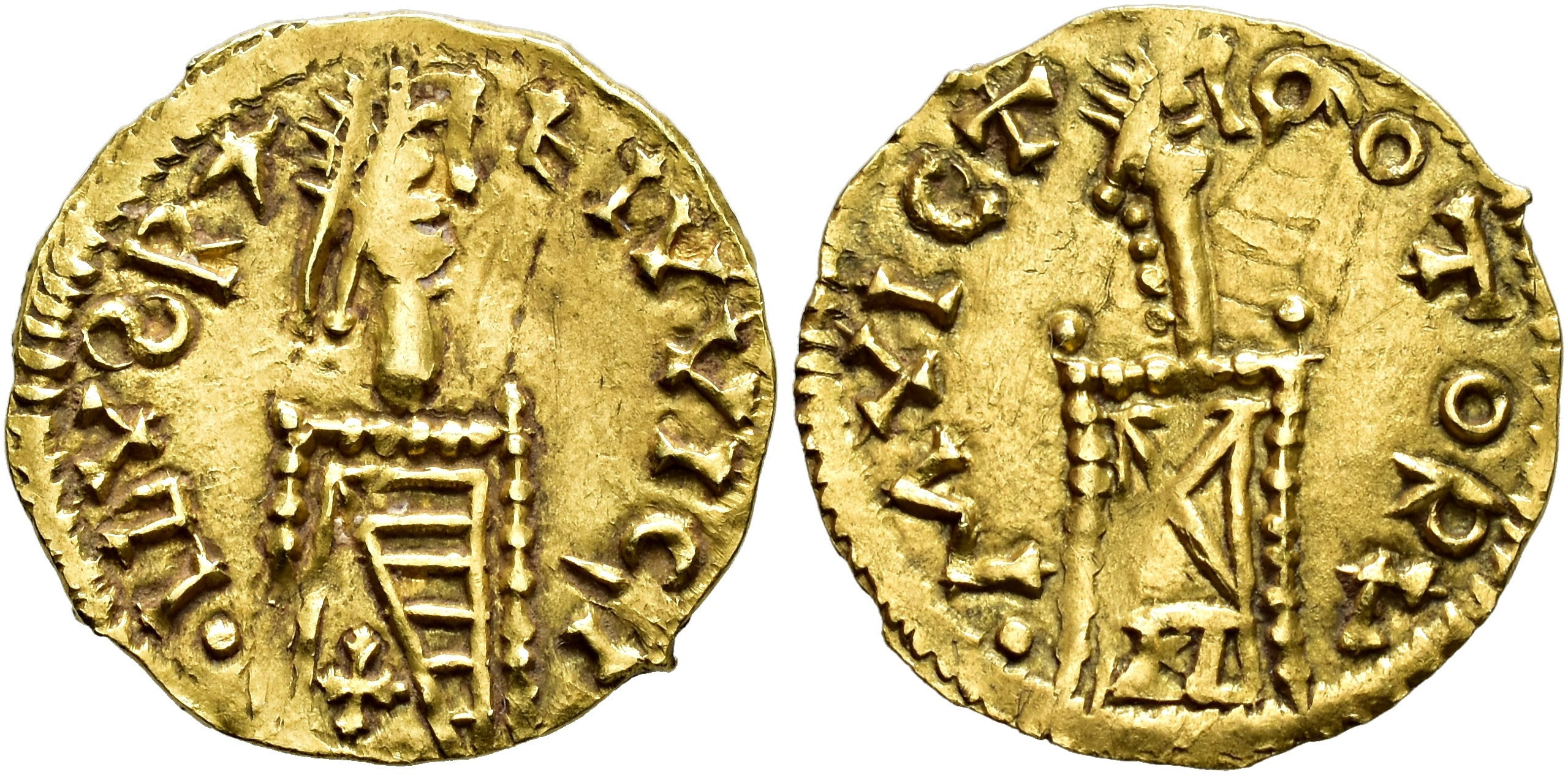
VISIGOTHIC KINGS. LEOVIGILD (568-586). Tremissis. Without mint. AU 1.38 g. 17.31 mm. Unpublished. Unique known specimen. Minor striking marks. VF+. Extremely rare.
Categories
NumismáticaAn important coin of a type hitherto unknown, with on the obverse a right-facing bust of Leovigild, the body rectangular with horizontal lines inside an inverted triangle, and a cross in the lower left corner. Legend: LIVVICI/.DVSRX. On the reverse - and this is the great novelty - appears a female bust to right, wearing a royal crown, with a plait and a fibula on each shoulder. We find no parallels for this figure in any other Visigothic coinage of the period. The neck is long and the body rectangular; within it appears a large X and below it the letters FL ligatured, the meaning of which we have not been able to interpret. What can be said, however, is that Visigothic kings, in documents and inscriptions, placed the Latin name Flavius before their Germanic names in order to legitimize their power and present themselves as direct successors of the Roman Empire. Legend: VICT/GOTORV/.M. Bearing in mind that Leovigild began placing his name on the coinage in 575-576, first on the reverse, while the obverse carried the name of the Byzantine emperor, later on both obverse and reverse, and finally only on the obverse, we would place this issue from those dates onward. It would fall immediately before the coins with the legend INCLITVS REX, dated 576-578 according to Miles and Reinhart, on which Leovigild presents himself to his followers enthroned and in royal attire, and also before the coins with a cross on steps on the reverse, based on the issues of Tiberius II that began from 578 onward according to Grierson. In historical context, after the death of Athanagild in 567, a serious succession problem arose. The appointment of Liuva, Duke of Narbonne and king in Septimania, did not satisfy the aristocratic faction of Athanagild's Toledan court, which gathered around his widow, Queen Goiswintha. The solution came in 568-569, when Liuva appointed his brother Leovigild as successor and associate on the throne to govern the Visigothic domains of Hispania. Leovigild ultimately consolidated his power by marrying Athanagild's widow, a key figure in legitimizing his rise, as noted by J. Orlandis and Garcia Moreno. One interpretation, in relation to the reverse legend VICTORIA GOTORVM, is that it may refer to a Visigothic victory. Leovigild's campaigns to achieve territorial unity were numerous and took place in different parts of the Peninsula. His great victories over the Byzantines occurred in 570 (Baza) and 571 (Medina Sidonia), and over the Hispano-Romans in 572 (Cordoba) and 573 (Medina Sidonia), but during these campaigns the coinage did not yet bear his name. This leads us to think that the issue of this coin may refer either to the submission of the Suevic king Miro in 575 or to the conquest of Orospeda, in the eastern part of Sierra Morena, in 577. Another possibility is to understand VICTOR as a nominative epithet continuing the obverse legend - a feature that would recur throughout the Visigothic kingdom - and GOTORVM as a partitive genitive. The interpretation of the legend would then be "the victorious one among the Goths". It may therefore be a ceremonial or commemorative coin on which Leovigild and his queen Goiswintha appear, with a legend exalting the king as the most victorious or outstanding among the Visigoths after his great victories in different parts of the Peninsula, the sum of which justified the glorification of his figure; or it may be a declaration of intent, intended to reinforce the unifying idea of the new Visigothic kingdom, pressured by the Arian-Catholic struggle and by the factions of the nobility. The reverse bust, wholly unusual for this period, in which the normal type would have been Victory, leads us to think that, following Byzantine models and imitating the coinage of his contemporary Justin II, on which his wife Sophia appears on the reverse, the figure on the reverse of the coin in question may be the powerful and influential Queen Goiswintha. Given the importance of this queen, some nineteenth-century scholars, such as Meynaerts in his Ghent catalogue of 1852, had already proposed that the obverse bust of a Leovigild piece from Narbonne might represent Queen Goiswintha (Memorial Numismatico Español). Likewise, in Monedas Visigodas del Museo Arqueologico Nacional by Mateu y Llopis, we find a note referring to Heiss, p. 84, no. 28a, which in turn refers to the Memorial Numismatico Espanol. In describing the campaign against Orospeda, it states literally that a medal of Leovigild, unfortunately no longer known today and neither traced nor described by the person who had it in hand, bore the geographical name Tucci. Who knows whether there he may have been acclaimed "victor", "just", or "pious"? This information is erroneous, however, since Leovigild has no coinage struck at Tucci, the first issue of that mint being that of Sisebut, thirty-five years later. The conclusion we reach is that this piece does not belong to a regular monetary series maintained over time, but is instead an exceptional issue commemorating a specific event or situation. On the basis of its style, weight and metallographic composition, we consider that it should be placed around the year 577.
Recomended lots
Confirm your maximum bid
You are bidding for €
At the time of auction we will contact you by phone:
Confirm your maximum bid
You are bidding for
€
Loading…
Conecting with the server
Are you sure you want to buy the lot?
Confirm your maximum bid
You are bidding for
€